Elongated Soft Palate
Hereditary defects
Cherry eye
Bulldog books
English Bulldog breeders
Bulldog Clubs
Bulldog shirts
Bulldog gift ideas
Bulldog fashion

bulldog information
Bulldog Information 2003-2006 © All rights reserved by The Bulldog Information Library 
Site Information
Site Map
Copyright & Credits
Guest Map
Guest Book
Contact
Recommended Books
Goodies
Music for Bulldogs
Cute & fun photos
Bulldog Names
Bulldog Gift Ideas
Bulldog Supplies
Bulldog Memorabilia
Canine Books
Bulldoginformation 2003-2005 © All rights reserved.
No part of Bulldoginformation may be copied, distributed or printed
without the owner's written permission.
Site Map |
Native Japanese Dog Breeds |
| Catahoula Leopard Dog |
Tosa Inu |
Bull Terrier |
Akita Inu |
Bulldog Breeds |
Hereditary defects |
Bulldog Names |
Quality and Genetic Diversity |
| Bulldog Breeders |
History of the dog
Bulldog Books
Dog breeding
Canine genetics
Puppy raising & training
Dog behavior
Behavior problems
Dog Aggression
Dog training
Dog showing
Judging dogs
Kennel management
Housebreaking a puppy
Dog Photography
Therapy dogs
Dog nutrition
Dog heroes
Related articles
Featured links
.

.

.
.

Elongated soft palate is most common with Brachycephalic dog breeds. The Bulldog, but also the Pug, Boston terrier, Pekingese, Boxer, bulldog, Shih tzu or any one of the other breeds with "pushed in" faces, are called Brachycephalic breeds.  The word comes from Greek roots Brachy, meaning short and cephalic, meaning head. They have been bred so as to possess a normal lower jaw, that is, one in proportion to their body size, and a compressed upper jaw.
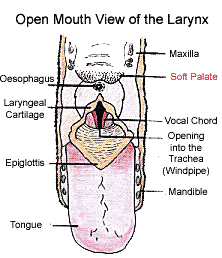
The soft palate is a flap of mucousal tissue which closes off the animal's airway (nasopharynx) during swallowing to prevent foods and liquids from going into their lungs. In animals with a normal soft palate, it touches or slightly overlaps the epiglottis.In the Brachycephalic breeds, it is difficult to fit the soft tissues of the canine mouth and throat into the short face. In dogs with an elongated soft palate, the palate then overlaps the epiglottis to a considerable degree, partially obstructing the animal's airway during breathing.
The signs of elongated soft palate are mouth breathing, snorting and snoring which gets more prounounced after exercise. It tends to get worse as the dog gets older. Not only will it impair the dog's ability to eat, but it will interfere with his breathing.  Generally he will regurgitate, or bring up, his food, often several times before he manages to digest it. In time, stretched ligaments in the larynx leads to labored breathing and laryngeal collapse.

Laryngeal collapse is a late stage in airway obstruction. Pressure changes caused by the elongated soft palate bring about the stretching of the ligaments that support the laryngeal cartilages. These cartilages gradually collapse inward which can lead to attacks of acute airway obstruction, and sometimes part of the soft palate needs to be surgically removed. Naturally, any dog that has suffered with soft palate should never be used as breeding stock.

This congenital condition affects the breed far less now a couple of decades ago. 
Sources:
Dog Owner's Home Veterinary Handbook, 3rd Edition by James M. Giffin MD & Liisa D. Carlson, DVM
Bulldogs, Christian Bruton
UC Davis Book of Dogs :
The Complete Medical Reference
Guide for Dogs and Puppiesby Mordecai Siegal

More information:
Dog Owner's Home Veterinary Handbook by James M. Giffin
More information:
The Veterinarians' Guide
to Your Dog's Symptoms
by MICHAEL S. DVM GARVEY

More information:
| More Dog breeds | Molossers | Bulldog breeds | Japanese dogs |
Home > Articles > Bulldog Health and Care > Elongated Soft Palate
Homepage
Puppy pages
Dog books
Bulldog costumes and clothes
Bulldog statues, lighting, candle holders
Bulldog supplies
Bulldog books
Photos
Articles
Books
Gift Ideas