The bulldog breeds include a number of breeds, which owe their heritage to Bull and Mastiff type dogs of indefinite origin.
The modern bulldog breeds descended from these dogs and those re-created through breeding programs keeping close to the original type and traits of the ancient bulldogs, even when adapting to their local living conditions, include:

alapaha blue blood bulldog
french bulldog
american bulldog
Presa mallorquin
Bulldog Breeds
(Different Types of Bulldogs, Bully breeds)

© Researched and written by Catherine Marien-de Luca


aussie bulldog
banter bulldogge
Olde English Bulldogge
Bulldogs owe their name to the fact that they were once used to guard, control and bait bulls.
Victorian Bulldog
The baiting of bulls before slaughtering them was based on the belief that that beef had a superior flavour and was more tender if the bulls were made to exercise before being sacrificed.
Custom Search
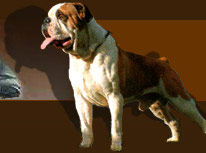
They  are characterized by a large head, strong, square build, shortened muzzle, strong and undershot jaws, which ensures a strong and efficient bite. Their character is often dominant and tenacious. Their hard and ferocious expression, which makes them disuasive guard dogs, is completely oppositie to their docility and sweet-hearted temperament. Their high tolerance to pain and courageous temper make them patiently tolerant with children, but also has the drawback of making them unsuitable for unexperienced or absent-minded dog owners, as they will often not complain if they are injured, ill or suffering from thirst, hunger or cold. Although they are good guard dogs, they do usually not excell as watch or "alarm" dogs, as they may "ommit" to bark and warn before attacking an intruder.

by Catherine Marien-de Luca © The Bulldog Information Library

See also: bull and terrier breeds,
Origin of the Mastiffs, Evolution of the bulldog, Bull Baiting

Common people, however, were not allowed to possess big dogs. The penalties for transgressors were harsh. With their typical astuteness the common people began to develop a smaller Mastiff, as strong and as ferocious as its bigger cousin, but with shorter legs.
As a result, meat of bulls which had not been baited, was considered unproper for consumption and butcher's who did not comply to the rule received a fine. In this way began the practice of using large dogs to harass the bulls. Combats between bulls and Bulldogs enjoyed popularity in the early and late middle ages. Queen Elizabeth I was a great admirer of these fights.
The genepool of the Bulldog has been modified through the years by selective breeding and judicious outcrosses creating new breeds which through their common background and unique characteristics may be considered as belonging to one and the same group. 
The word bulldog appears for the first time in 1632 in a letter written from San Sebastian in Spain by Mr P. Eaton to Wellingham, then living in London, in which he asks to be sent " a good Mastire dog, a case of liquor and I beg you to get for me some good bulldoggs", in which, for the first time, the Bulldog is clearly distinguished from the Mastiff.  See also: bulldog history.


Bulldog Information Home
.

.

.
.
The original bulldog followed the immigrants and travellers around the world, were they adapted to the local working and living conditions (American Bulldog, Bulldog Campeiro), sometimes being bred down (like the French bulldog, Old Boston Bulldog) to adapt to the cramped living conditions of the working class immigrants, or crossed with local breeds to reinforce specific skills (Catahoula Bulldog).
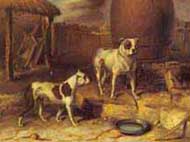
Historically the bulldog breeds originate from the fighting dog breeds and molossian dogs of Antiquity. Roman historians described the fierce Greek, Molossian dogs and the "pugnace britannicii" or fighting dogs of Britain used in battles. These British fighting dogs were of two types: the larger Mastiff type guard dogs and the smaller type used for herding and protecting livestock. At the time of the popular bull fights, the bulldog breed was selected for its particularity  to attack the nose of the bull and hang on without loosening its grip instead of using the slashing attack from the rear preferred by most dog breeds. Historical pictures proof that these dogs were of the mastiff type, but with their appearance varying.


Related articles
The Working American Bulldogby Dave Putnam
excellent source of information for the AB owner wishing to learn more about the breed
More information


The Bulldog Information Library 2003-2010 © All rights reserved.
Original idea, design and development by C. Marien-de Luca. No part of bulldoginformation.com may be copied, distributed, printed or reproduced on another website without the owner's written permission. Please feel free to link from your site to any of the pages on this website in a non-frame presentation only.
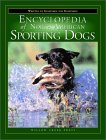
The Encyclopedia of North American Sporting Dogs: Written by Sportsmen for Sportsmen
by Steve Smith (Editor)
More information

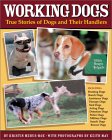
Working Dogs : True Stories of Dogs and Their Handlers
by Kristin Mehus-Roe
Explores the many ways in which dogs historically and currently serve humankind in the workplace, while encouraging sensitivity to the needs of working dog breeds kept as pets.
More information
Decoys and Aggression
A Police K9 Training Manual
by Stephen A. MacKenzie
Good for both novice and seasoned trainers
More information
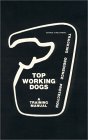
Top Working Dogs: A Training Manual--Tracking, Obedience, Protection
by Dietman Schellenberg
For beginners and experts alike in the fields of tracking, obedience and man-work.
More information
Recommended Reading
Home
Recommended Books for Dog Owners
Bulldog breeds
Dog breeds A to Z
Molosser breeds
Guard dogs
Japanese dogs
Best dogs for families with children
More dog breeds
Bull and Terriers
Sled dogs
Hairless dogs
Toy dogs
| Dog articles | Dog Magazines |
Home > Molosser dogs > Bulldog breeds
About Bulldoginformation.com: Sitemap | About us | Privacy | Copyright | Contact
Valley Bulldog
English Bulldog
Dorset Olde Tyme Bulldogge
Crib & Rose
Source: Dog Painting
Bull and Terrier breeds
Dogo argentino
Tosa inu
Dogue de Bordeaux
Guard dogs
Molosser dogs
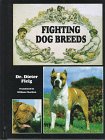
Fighting Dog Breeds by Dieter Fleig
Fighting dog breeds
Dieter Fleig
More information:

The Story of the Real Bulldog
The Story of the real Bulldog
More information:

The world of Fighting dogs
The world of fighting dogs
Carl Semencic
 More information:
Beware of recently published books about bully breeds. Some of these have directly taken their information from our website (without ever mentioning their source, of course), using terms we have coined (as some neologisms used in the Ca de Bou and Brazilian Bulldog descriptions) and conclusions we have drawn. The info they have used without giving us credit is based on OUR first-hand experience. We have personally contacted ALL foundation breeders we mention on our pages and collected additional info while living in and traveling through the countries these dogs are native to. Something those authors can not possibly claim. The irony is that they give thenselves away be mentioning the very same selection of bulldog breeds we have featured on this website (while there are at least 20 more bulldog breeds out there, some of which more famous than the ones we have selected for this website). While we have mentioned only the breeds we have personally checked and researched, it seems strange they checked and researched exactly the same list of breeds...

Our suggestion is:
Before you buy a dog breed book, check who the author is. Is their info first-hand or just a collection of bits and pieces they reproduced from the internet and previously published books. Of course, research is always based on something that has been published or written before, BUT if it is done seriously sources and references are ALWAYS mentioned. So a good hint to see if a book is worthwile is to see if the book has a reference list or bibliography (especially if the book was published after 2003 or 2004, when so many sources become easily available through the internet. Today, nobody can claim they wrote a book without consulting the internet and previous sources on the topic). If a reference list is mentioned you can be sure that the research done by the author is fair and up-to-date. Every author who is serious about his work and  has done an in-depth research on a topic wants to show you the path he/she followed by mentioning his sources.

Older books (such as the three ones mentioned hereafter) may not always have a bibliography. However, unlike some of the more recent, coffee table books, the three books mentioned here are classics in their field and stem from genuine dog authors and authorities who really know their subject !
 The older the book, the higher the chances the info is based on the author's first-hand experience and is not just a marketing stunt. Otherwise the books mentioned on this website are usually all reliable sources.