.

.

.
.
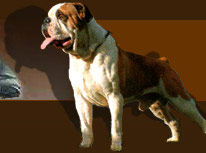
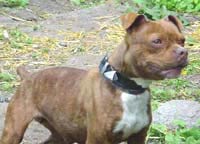
Olde Boston Bulldogge
(Old Boston Bulldog)
The Olde Boston Bulldogge is the original "round-headed" Bull and Terrier of the Boston area, Massachusetts.  This is the breed from which the Boston Terrier was developed, therefore the Olde Boston Bulldogge and the Boston Terrier share
the original old type Boston Terrier to make it look like the present-day Boston Terrier. In the early history of the breed, however, there was no established type, some favoring the bulldog-type, while others preferred the terrier-like specimens. They were called "Round-headed bull and terriers" or short "Round Heads" and "American Bull Terrier". The dogs that were used in the fighting pits were also used as family dogs.
the same early history.

Like most dogs used for pit fighting in the 1800's the original Boston Bulldog resulted from a cross between bulldogs and terriers (more specifically from the English Bulldog, the Bull terrier and the White English Terrier), and
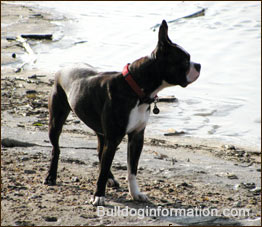
Today, while the Boston Terrier bares no ressemblance with the Olde type Bull and Terrier of Boston used in pit fighting, the Olde Boston Bulldogge has been kept close to its historical model of the 1800's.  Much if not all of the credit for preserving and re-establishing the Olde Boston Bulldogge should be given to the late Mr. Neil Rutan and his family. Mr. Rutan's wife and son Nathaniel continue today to be dedicated breeders and supporters to this wonderful breed.
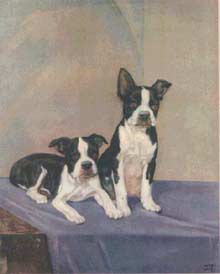
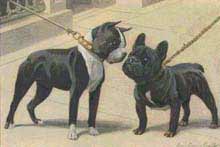
Old Boston Bulldogge painting
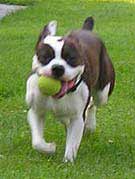
While the boston terrier is much smaller and only comes in brindle/white, black/white, seal/white, the Olde Boston Bulldogge is bigger (supposed to be what this dog originally looked like before it was bred down) and comes in all colors like the bulldog.  The Boston Terrier should not weigh more than 25 lbs.  The boston bulldog can weigh any where from 25 to 45 lbs.  Furthermore, with the Boston Terrier full colors or white heads are not acceptable.  They should have white front legs and white legs up to the hock in the back (desired markings).
The Olde Boston Bulldogge is registred with The National Dog Registry For Rare Breeds and Working Dogs and recognized by the IOEBA.
So, they had to demonstrate a loyal and friendly character, on top of their ability to fight.  Their devotion to their masters was legendary.

So, while the Boston Terrier were being refined, and eventually developed into a toy breed, the original Boston Bulldog, which was considered not refined enough because it had too much bulldog influence, continued to be bred separately. 
Over time, opposition arose from bull terrier and bulldog fanciers about the similarity of the breed's name.  A noted writer and authority, James Watson, thus suggested that
varied in form.  As a result some had the long, clean head of a terrier; others, the round, almost puggish head of the bulldog at that time. Most people believe that the French Bulldog was crossed in along the way, explaining the Boston Terrier's bat like ears. 
since this new breed did not resemble the Bullterrier, the dog should have its own breed identity. He felt that this dog having been bred in and around Boston, it should be named the Boston Terrier. So, in 1891, the American Bull Terrier Club changed its name to the Boston Terrier Club of America and changed the name of the breed to the Boston terrier. The breed was accepted into the American Kennel Club in 1893. 
Other smaller imported dogs are reported to have been used to further breed down
SMALL MOLOSSERS
( Small Molossians)
Over the years the tendency has been to reduce them in size.  In the early 1900's, one can still find Boston Terriers being shown in the Conformation Ring weighing around 30 pounds.
However, in the 1920's breeders started to pay more attention to the body proportions and markings on the body. Pit fighting lost popularity while the development of the
industrialization and urban living conditions increased the demand for smaller-sized companian dogs. By the 1950's the Boston Terrier was very much like the dog we know today.
Related articles
French bulldog
Boston Terrier
Pug
Other bulldog breeds

Molosser breeds
English bulldog
Bull terrier
| More Dog breeds | Molossers | English Bulldogs | Bulldog breeds | Japanese dogs |
Related books
Living With Small and
Toy Dogs
: Training, Behavior,
and Personality Differences

by Terry Jester

more information:
Boston Terrier and French Bulldog
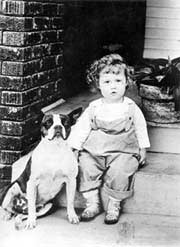
Boston Bulldog 1910's
As far as we know there no books have been written about the Olde Boston Bulldogg specifically .  However, as the Olde Boston Bulldogges share their early history with the Boston Terrier the following books are interesting for their description of the breeds' history and for the historical pictures and illustrations of the early Boston Terriers.
The Official Book of the Boston Terrier
by Lee Muriel, Muriel P. Lee
more information
Boston Terriers: The Early Years
by Cathy J. Flamholtz (Editor)
more information
Murphy & Taylor
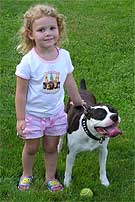
Photo: Jamie
McCormick
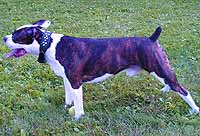
Bostonetts, Canada.  Photo: IOEBA
Photos courtesy Nathaniel Rutan, Rutan's Olde Boston Bulldogs,
Jamie McCormick  and Linda Harper (IOEBA)
Rutan's Murphy
owner: Jamie
McCormick
Bostonetts Canada
Rutan's Murphy
owner: Jamie
McCormick

For more information:
contact Mr. Nathaniel Rutan, Rutans Boston Bulls
Wired Kennels, Olde Boston Bulldogges breeder, Texas
Good Time Bostonetts, Ontario, Canada
IOEBA, the registry for alternative bulldogges and rare breeds
Molosser breeds
Dog breeds home
Guard dog breeds
The Bulldog Information Library 2003-2006 © All rights reserved.
Original idea, design and development by C. Marien-de Luca. No part of bulldoginformation.com may be copied, distributed, printed or reproduced on another website without the owner's written permission. Please feel free to link from your site to any of the pages on this website in a non-frame presentation only.
Related pages:
Bulldog breeds homepage
Boston Terrier

Bull-and-Terrier Breeds
Molosser Breeds
English Bulldog