South African Boerboel (Boerboel, South african Mastiff, Boel)
This large, powerful South African breed is claimed by its supporters to be THE guard dog par excellence. It is said to be the only breed in the world specifically bred to guard and protect without being aggressive. Their even character along with a 'sixth sense' that enables them to know what you are thinking, and when you feel threatened, are their main qualities. They are sensitive enough to know when you approve or disapprove of a stranger, and instinctively recognise your fear. However, they will only act if they detect hostile intentions or if you ask them to do so, rather than confronting everybody entering the house in a crudely aggressive manner as some other breeds of guard dogs.
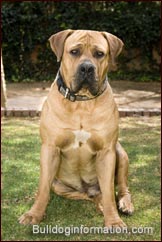
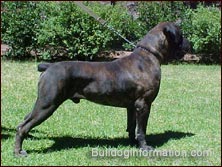
Boerboel (male)
Owner: Jana van Jaarsveld
Photographer: Daleen Loest
Origin and History
The exact makeup of the Boerboel is unknown, but it is known that various European breeds brought by the settlers and indigenous African dogs count among the ancestors of this distinctly African dog. Boerboel stands for "farmer's bulldog", "boel" being the Afrikaans spelling for bull(mastiff) and "boer" the Dutch word for farmer.
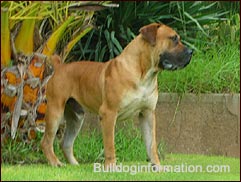
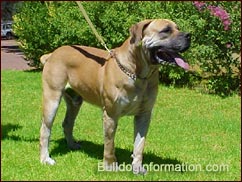
a superb male Boerboel
Photo courtesy of Egoli Boerboels
.
.
.
.
Originally the Boerboel was used by the Boers for hunting big game and protecting them on their ranches, but more recently the Boerboel has been employed almost exclusively as a family guardian. More about the Boerboel's temperament.
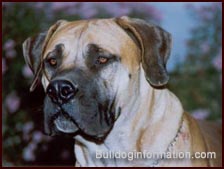
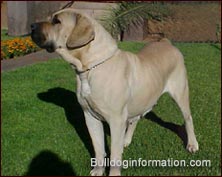
a beautiful portrait of Boerboel Egoli Simson
Photo: Egoli Boerboels
These dog and their descendants doubtless interbred over the centuries with other local dogs, such as the Khoi dog and the Steekbaard, and natural and functional selection will have shaped the breed to fit the local conditions.
According to historical records, the Dutch East indian Company sent Jan van Riebeeck to establish a trade post at the southern tip of Africa. In 1652 he arrived in the Cape, bringing with him a "Bullenbijter", a large and strong mastiff type of dog. Later settlers, including German and French, also arrived in Southern Africa with their molossers and large dogs.
Following the Anglo-Boer war at the turn of the century, the locally bred dogs were further cross-bred with various imported dogs, possibly including early varieties of the Bulldog, the Great Dane, the Saint Bernard, the Bull Terrier and later the Bullmastiff, thereby consolidating the mastiff component of the breed mix which was already present. The Rhodesian Ridgeback undoubtedly also contributed to the gene pool of the Boerboel.
While the Mastiff component in the Boerboel is undeniable, in some Boerboel pictures, the Rhodesian Ridgeback influence is clearly discernable.
The history of the Boerboel and the Afrikaners is largely interwoven. The Boers (the early South Africans) who refused to live under British rule, took their families and animals with them on the Groot Trek (Great Trek) to interior regions beyond the sphere of British influence. The Boerboel shared the harsh conditions of the mass exodus, traveling long distances, guarding and protecting the belongings of his masters by night.
Boesman & Lady
Photo: Nigel Delo, George, Western Cape
In the 20th century the breed was nearly extinct, but five founder members of a newly formed Suid Afrikaanse Boerboeltelers Vereniging (SABT, in English: SABBA, South African Boerboel Association) started restoring the breed from the remaining full-blood Boerboels they could find in more remote areas were the dogs had not been subjected to random matings.
A search covering thousands of kilometers followed in August 1980 and different groups of dogs were identified. In the high-lying areas of the southern Free State and Kwazulu-Natal dogs were discovered that differed slightly from other dogs in the more north-western areas. For example, the dogs from the high-lying areas had longer hair, with thinner legs, smaller feet and sharper muzzles than those in the north-west.
The isolation of the different groups can be traced back to the start of the Groot Trek (Great Trek) in 1838, which explains why there are so many differences among these dogs. From hundreds of dogs only 72, those identified as the most representative specimens, were retained and selective breeding programs started. The results were not always conclusive but the association persevered in their effort to register the last dog of their forefathers as a pure breed.
The definition of the breed has been achieved since the establishment of the SABT in 1983, and the first nationwide appraisal of dogs which took place in 1990. Now, the South African Boerboel Breeders Association has grown to over 500 members. They are widely spread throughout South Africa and Namibia. They work together with the Historical Boerboel Association of South Africa (HBSA), the European Boerboel Association and the United States Boerboel Association for the preservation and promotion of the breed, and interest in the Boerboel as a highly efficient guard dog is spreading around the globe, especially in Europe. Superior Boerboels were exported to countries such as Belgium, Holland and Germany. In the States you also have the American Boerboel Club (affiliated with the AKC) working to have Boerboels AKC registred.
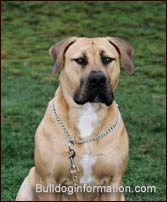
Boerboels are not as big as English Mastiffs, but bigger than Boxers. They may be compared to large Rottweilers but with a solid color coat. Actually, many coat colors are accepted but breeders tend to obtain solid colors with little or no white, ranging from cream white, pale tawny, over reddish brown, brown and all shades of brindle. Eyes are light or dark brown.
Coat color is not just a matter of cosmetic preference; brindle Boerboels tend to be milder in temperament than red Boerboels.
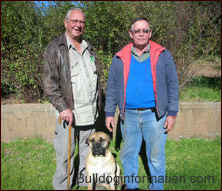
Mr. Lucas van der Merwe (left) and Jan from Egoli Boerboels. Mr. van der Merwe is the only breeder still active today who took part in the tour of 1980.
Training Dogs:
For Protection Work
by Fred Mandilk More information:
An Owner's Guide to Raising Your Pet Protector
by Lori Berg, Michael ''Gypsy'' Stratten More information:
PIT BULLS & TENACIOUS GUARD DOGS
byDR. Carl Semencic
contains a chapter about the
Dogo argentino More information:
"Tiamaria"
Photo: Lynne Berridge,
boerboels.co.uk
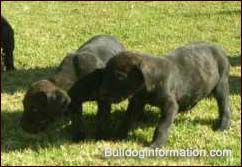
dark brindle pups
Egoli Boerboels
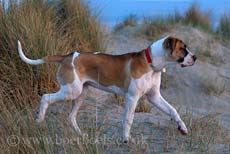
Afrika's Tina
C.G.C, OB.1, B.S.T, H.I.C
aka Hannah Marie
Photo: Marcella and Gordon Burgess
Proudfoot kennels
Generally males grow from 60 to 72 cm tall and weigh approximately 55 to 70 kg. Females are usually slightly shorter around 55 - 69 cm and weigh less, around 45 -60 kg.
Temperament and Character
The Boerboel is loving, calm, obedient and intelligent, with strong guard-dog instincts. Boerboels are self-confident and fearless, requiring a dominant owner, able to keep his alpha position within the pack.
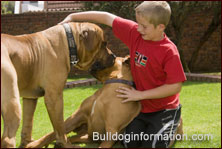
They are affectionate with children and make an ideal child's playmate.
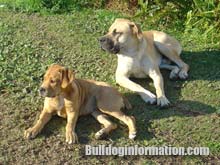
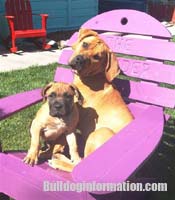
Boerboel pups
Photo: Lisa Cloutier
Photo: Daleen Loest
The following books contain a chapter or entry about the Boerboel:










 Home
Home Dog Breed Finder
 Dog Breeds A to Z
 Molosser Breeds
 Bulldog Breeds
 Flock Guard Dogs
 Guard Dogs
 Swiss Mountain Dogs
 Bull-and-Terriers
 Terriers
 Hunting Dogs
 Water Dogs
 Hypoallergenic Dogs
 North American Dogs
 British Dog Breeds
 Scandinavian Dogs
 German Dog Breeds
 Turkish Dog Breeds
 Asian Dog Breeds
 Chinese Dog Breeds
 Japanese Dog Breeds
 Russian Dog Breeds
 Finnish Dog Breeds
 Hungarian Dog Breeds
 Romanian Dog Breeds
 Laika Breeds
 Sled Dogs
 Hairless Dogs
 Ridgeback Dogs